This week’s reflective blog will act as an update of our group’s Museum project. The subject of our project is a ceramic tomb figure of a court lady made with earthenware and pigment. Its date of origin can be traced back to 618-907 in Sichuan Province, China.

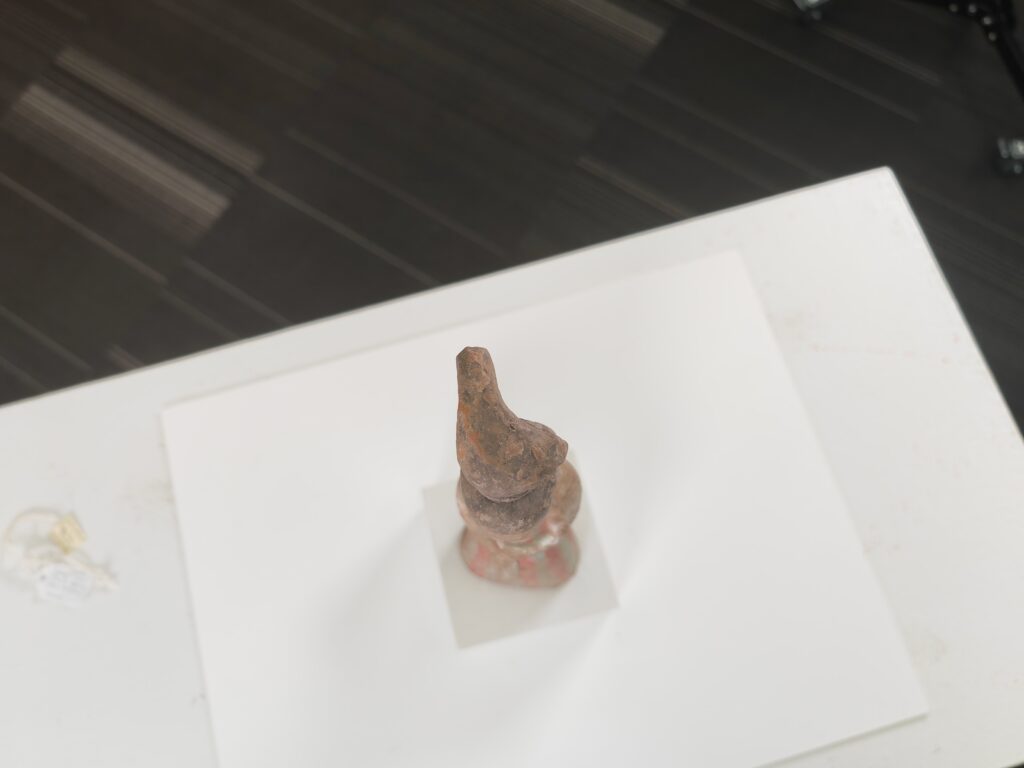

Above are photos of the figure that we took early this morning in Perlman Teaching Museum Classroom. It was set on a table specially designed for photograph-taking with two movable lights around. We took a total of 163 photos all around the figure, including some details like the grooves and curves of her court hat and arms.
How does attempting to model an object compare to simply viewing one in an exhibition?
Viewing objects in an exhibition is more like a tour during which you watch and enjoy the sceneries along the way. You do not have to pay much attention to any of them, though you can if you wish. It is more relaxing and flexible. Also, you may not focus on an item itself much but the history and/or culture it represents. Attempting to model an object is more like raising your own child. You want every aspects of it to be perfect, the grooves, curves, shadows, and streaks. You definitely only focus on the item itself and try to duplicate as much closer to it as possible.
Does the process of photogrammetry encourage close looking and attention to details you might otherwise have ignored?
Of course. As answer to the previous question has said, if you try to make a perfect duplicate of your object, you must observe it in full detail. For example, one detail that I noticed during photo-taking was that due to erosion over thousands of years, part of the skin of this court lady showed the original color of the clay. This observation leads me to a question whether the skin was painted with pigment and showed the inner clay with erosion or the skin was not painted but just a difference between eroded clay and clay underneath.
How does moving from passive observer to active modeler change your thinking on communicating about art and history to various publics?
To me, duplicates means opportunities of wider spread of culture. The original item of cultural relic is in need of protection from many sources like oxidation, falling, breaking, etc., while truly having spectated cultural relics leaves a more impressive figure in people’s mind. Duplicates of 3D printed version can help with both problems at the same time.