The Rhythm of Food is a DH project that gathers information from Google search interests to analyze the change and trends in people’s food preferences over years. The purpose is to investigate the dietary habits of internet users based on their online searches. It provides audiences with a creative visual presentation of data analysis. The project was done by Google News Lab and an individual designer Moritz Stefaner, and all Data are sourced from Google Trends, which are publicly available. In the course of this project, the team first analyzed hundreds of ingredients, receipts, and other food-related search terms. They then explored the hidden patterns in Google search data and presented their findings graphically with diagrams and general trend lines.
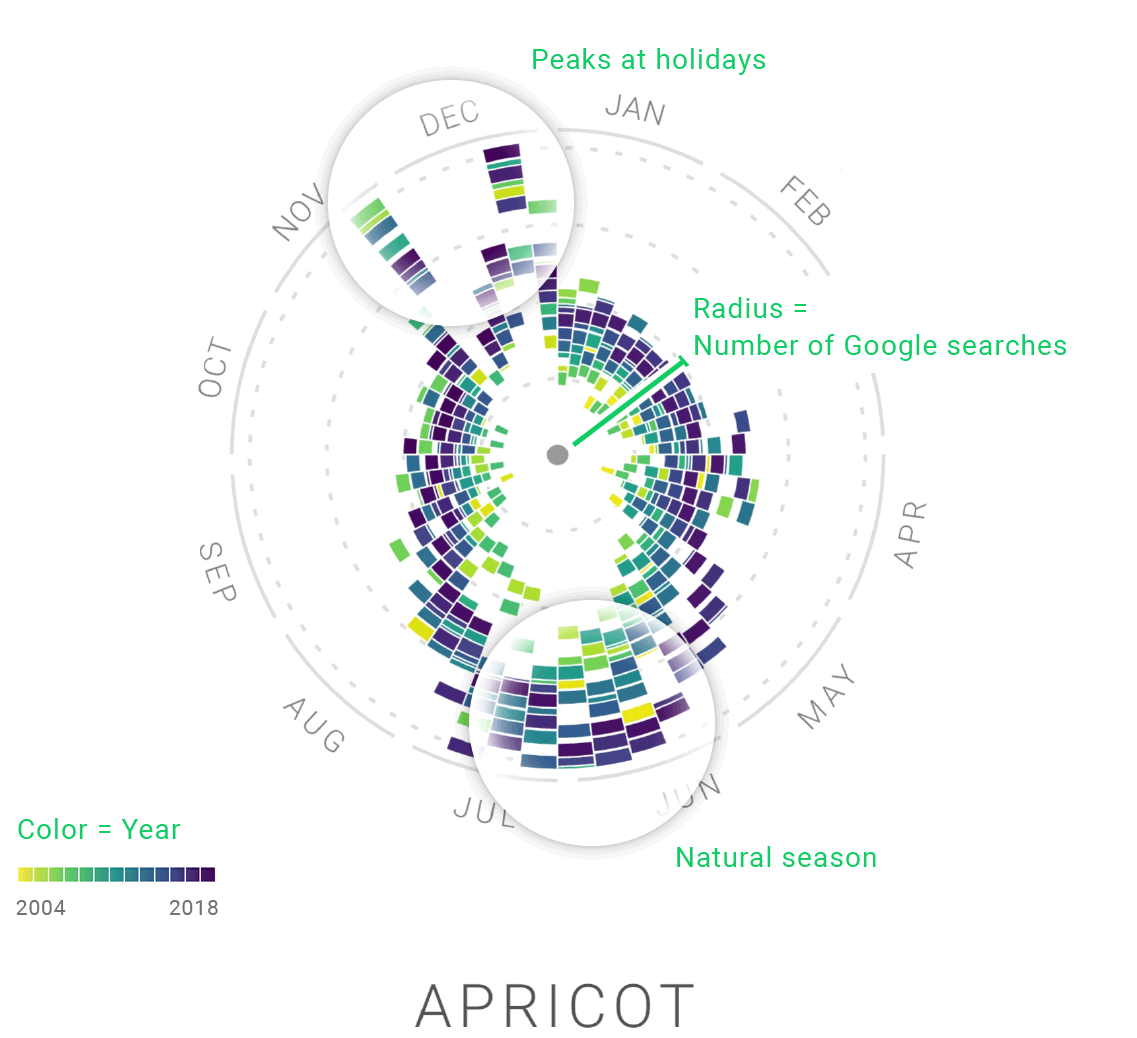
This project uses interactive year clocks to summarize the results. As shown in the example above, different colors indicate different years, and the radius indicates the number of Google searches. As provided on the website, several reasons can explain the peak of searches at certain times of the year, such as holidays, special events, and natural seasonal changes. For example, nachos become very popular on Super Bowl Sunday since it is a particular favorite snack of this sport event. Fruits and vegetables are most affected by seasons; they fade in and out of a natural season. Moreover, there are comparisons of an item’s search trends around the world, which are largely impacted by variations in seasonality. This graphical presentation of the data is straightforward and not overly technical. Its creativity and simplicity manage to attract a great range of audiences. However, I don’t think it is conveying any argument or addressing any issue. Therefore, My question is what do they want their audiences to conclude from their project?
This project is in conversation with some academic fields. Since the topic is about food, this analysis can be used as a resource for Nutritional Science. It is also related to Modern History and Sociology as it draws connections between food and special events. In addition, it can be applied to psychology. For example, the data shows that New Year’s resolutions lead to a peak in the term “diet”. Some psychological concepts might be able to explain this peak.