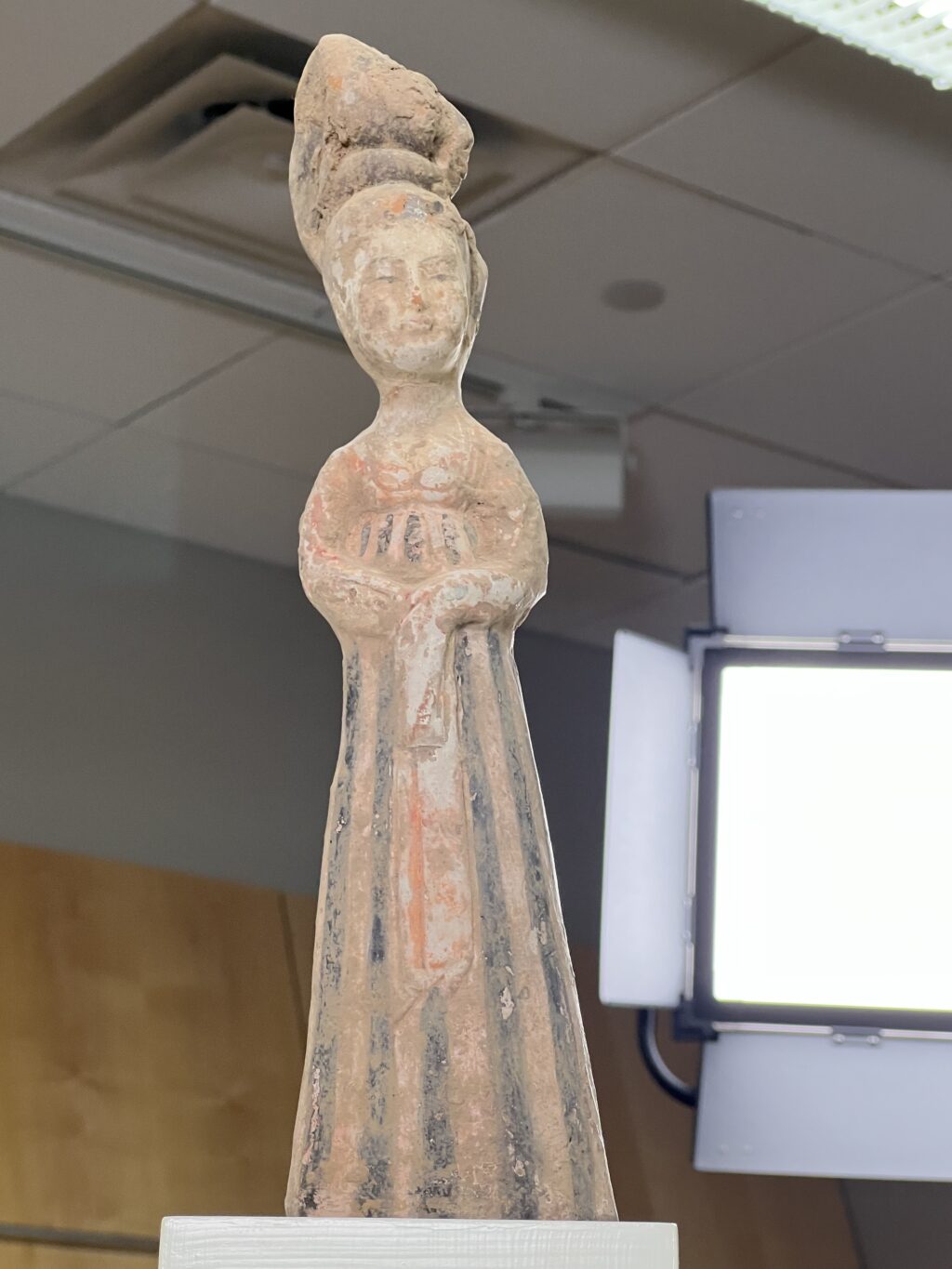
While at an exhibition, there is no pressure to see every angle of an object. You can simply admire the art for being art. Then, in some cases, certain angles are impossible to see due to other objects being in the way, access restrictions, or objects being at a far distance. However, if you are attempting to model the object, you must try your hardest to photograph every angle from certain distances, lighting, heights, etc. You are more focused on capturing the moment than experiencing it.
Then again, there are pros to modeling an object. For example, say you were at a museum looking at small objects like coins, pendants, pins, etc. You can zoom in on a model to get a closer look at the small details, but you may not be able to get any closer than allowed in the museum. Also, while at a museum, you may just take quick glances at an object and continue on, while modeling an object requires you to take your time and look at every aspect.
Engaging with objects through 3D modeling makes me wonder what the limits are. For example, if you made a super realistic 3D model of all the art pieces in a museum, could you print them all out and start your own 3D model museum? Would this violate copyright laws or anything? Also, say you just made an online museum using 3D models; would that affect the number of people who visit the museum?
Changing from passive observer to active modeler didn’t really affect me all that much. Then again, I personally don’t find museums interesting. However, I did think about the cases where I did like an object at a museum. Could I find the 3D model online and then create it to have at home? That part is fascinating to me, but the whole experience of taking the photos and creating the model was “eh” to me.
I appreciate your honesty about your lack of interest in museums, but also how 3D modeling potentially changes the idea of having a museum in the first place. I wonder how museums are already adapting to this progress in technology, but also still trying to have a compelling business model. It leads me to the question, what is the price of knowledge? Should knowledge and access to information be free to everyone, no questions asked? The consequences of the internet lead me to say that the answer is no, but I’ll now be thinking about that.
I have a similar sentiment towards museums that you do, and so I thought a lot of your perspective was interesting. I particularly liked the questions you asked about whether 3D modeled exhibits could ever replace a real museum. I think this would be really difficult because even with the benefits of 3D modeling, there are still some aspects to museums that can not be captured. For some people, going to museums is about seeing the original piece and understanding the history even if they can’t see all the details. To me, it is similar to the idea that prints of famous works of art are sold for far less than the original would be.
I really appreciate your comment about what the limits behind 3d modeling are. I wonder if eventually the original pieces of art will begin to lose their value as 3d models will become the most easily accessible, and if those 3d models will result in more printed versions of the original artifacts. And if 3d prints become common, how any version of copyright or likewise validity concerns come into play.
Haha I definitely see your point in that there is a lot of pressure when trying to capture photos for photogrammetry. When we were taking the photos, we made sure to be extra careful not to alter any lighting between shots, we made sure that the camera had the same focus for every shot, and we tried to get every angle we possibly could without touching the object. All of it felt a little scary as we were constantly questioning each position and photo we took a picture from; how is this lighting? Does this get a solid portion of the object? Do we think the software will be able to compare the pixels in this photo to the others we have taken?
My group focused on a similar object and I actually had a similar feeling when modeling; the process of picture taking was no fun, which does not really help me understand the sculpture that much. And in general, although I do not wholeheartedly agree with you, I appreciate your honesty in expressing a somewhat unpopular opinion.
Interesting post. I do agree that when modeling you are more focused on capturing the moment than experiencing it. Also, you posed a very interesting question about this process with copyright laws. When considering the differences between 3-D printing objects and the actual pieces, I mainly considered the advantages, but this was an interesting disadvantage.
I thought this was a really thoughtful post. You weighed out pros and cons for each side of the “debate” that has arisen through this lab, and to hypothesize over whether or not 3D model museums could eventually replace real museums is a step I would’ve never thought to take. I like museums, and I feel like more often than not when I go to any random one, they’re reasonably crowded (sometimes too crowded). I think the history a lot of these buildings hold can and should be made available online as interactive 3D objects, but people still really like to go see the stuff in person. Awesome post!